|
 Randolph Trail / Feather Hawk Falls:
August 11, 2012
Sipsey Wilderness, AL
Distance: 8 miles
[View Photo Gallery]
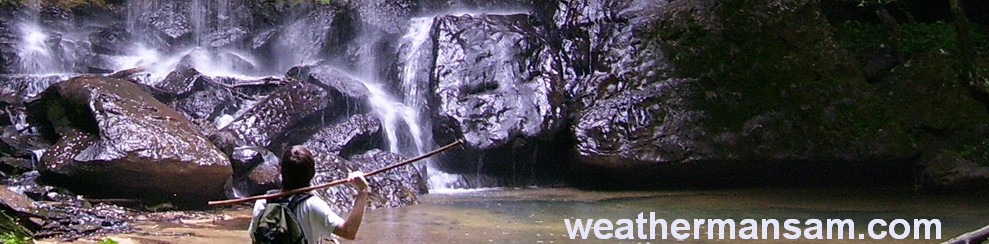
This month on wilderness ranger patrol, Mary, Parker, Larry and myself visited TR 202, the Randolph Trail and an adjacent canyon, home of Feather Hawk Creek and it’s associated waterfall. While the waterfall was unfortunately nearly dry, the unusually cool August day and an abundance of Cranefly orchid, a surprise discovery, more than made the outing worthwhile.
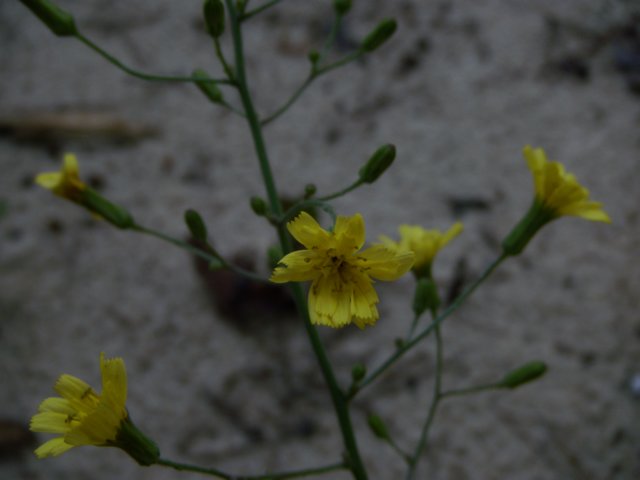
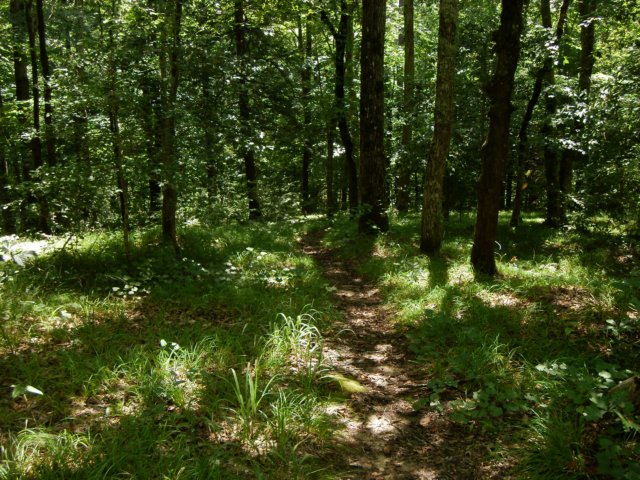
I’ve said it before, and I’ll say it again, I don’t like this trail. It’s a knee killer coming out that offers little reward usually in exchange for traversing it. However, I was lured by the previous night’s rain [I’d thought the area received 4-5 inches, based on reports] that’d made me hopeful that Feather Hawk Falls, the last remaining waterfall on that side of the wilderness area I’d yet to see, would be flowing in good form. The ground was definitely wet, we unwisely opted to not apply bug spray, expecting the two things that generally keep me from extensively hiking in the summer, ticks and chiggers, to be washed down or away. After logging a coordinate at the really dangerous deadfall hanging across the trail we’d first noticed on our last patrol here, we made our way to the old road bed section of the trail. To my surprise, we found a variety of wildflowers in bloom, signaling the onset of the summer/fall cycle of plants, early, like everything else this year. We found plenty of black-eyed susan, along with patridge pea and leafy elephant’s foot, something I’d never seen before. We made a brief stop at one of the Johnson cemeteries to check for litter, where I found another plant I hadn’t seen before, hairy hawkweed.
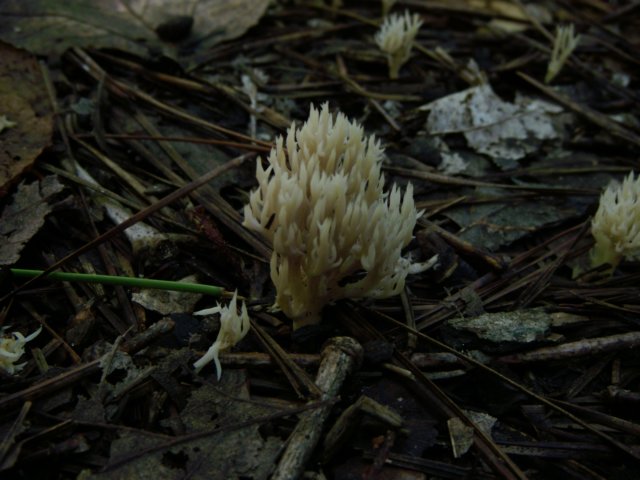
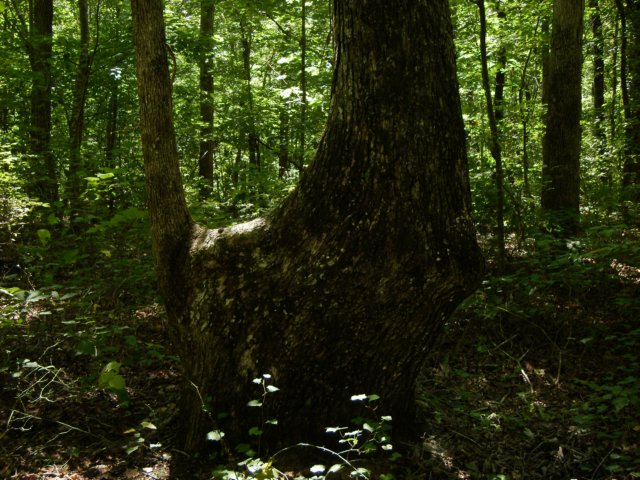
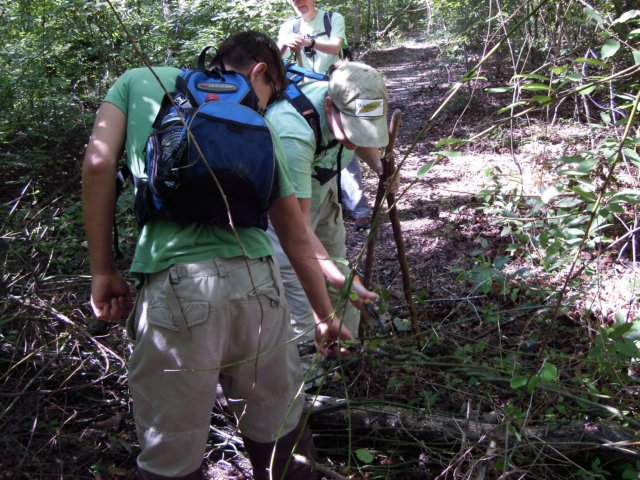
 Not far downhill from the cemetery we cleaned a large mess of vines intertwined with random dead limbs that was a huge trip hazard and was nearly blocking the trail. We also worked some on a smaller tree that had snapped, but was still hanging on by a strip of bark. Here a group of three people, a young girl and her parents, passed us. They were the only ones we saw the entire trip, and we’d meet up again late. Soon after we came to a short social trail marked with a red bandana and a rather large fire ring. About half an hour was spent rummaging through the ashes, near filling a garbage bag full of broken bottles, rusted cans, cigarette butts. We destroyed the fire ring, and naturalized the area as best we could in hopes it won’t be used again. For a while after, the forest relaxed a bit as we descended slightly into more mature mixed hardwoods, and stumbled across a nice patch of coral fungi and the ‘giraffe tree’. [I later learned coral fungi are a good sign that orchids may also be growing in the vicinity. I wish now I’d taken a waypoint!] The giraffe tree as Mary called it [which is what it looks like, in a way], I suspect is actually an indian marker tree, possibly outlining an old path here as there aren’t in shelters in this immediate area. After visiting the massive oak tree with old rusted car to boot, we began an uphill climb again and made our way through the just-close-your-eyes-and-keep-moving portion of the trail.
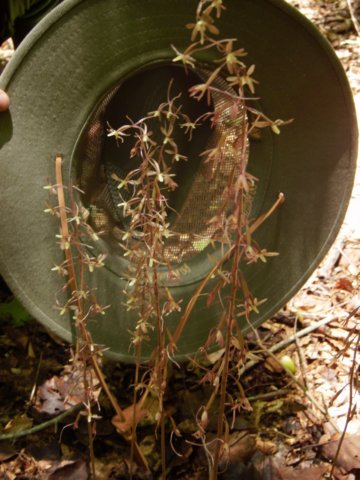
 The next descent brings one into hemlock territory, and we stopped to gaze out down the canyon, Feather Hawk Creek Canyon, to be exact. After cleaning up the very popular campsite that sits in small grassy area, I found the trail splits now. A social trail leads straight down to the river, bypassing a decent section of the Randolph Trail, and missing it’s gorgeous waterfall [when it’s flowing]. Since we were going to venture up Feather Hawk Creek, we opted to take the real trail down. Here, I caught a glimpse of something poking up out the ground, and did a happy dance! It turns out we hiked when Cranefly orchid was at the height of it’s bloom cycle. I took a ton of photos of this one, not sure how many more we’d find [we found 60+ that day], and then for a while, stopped numerous times to study and compliment each new grouping. We made it to ‘Randolph Falls’ [my name for it, nothing official], barely a trickle over the edge. As we took a break for some water, the father and his daughter we passed earlier met up with us again, and we chatted about the forest, Leave No Trace, and the girl wanted her photo taken with us, and we happily obliged. This last section of the Randolph Trail I really do like. It’s a different world than the longer ridgeline portion with the hemlocks, lush plants and bubbling little creeks. When the trail leveled out in the bottoms, we met up with the mother of the group, who had opted to stay and rest by the nice campsite here. After a brief, we headed on down to the river itself to look for where Turkey Foot Creek joined in.
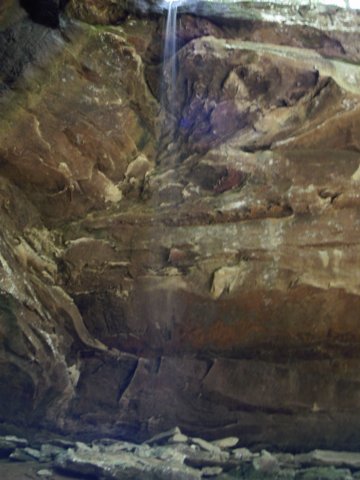
 We quickly found the junction, hiked upstream and always the daredevil, crossed on a shaky fallen log while the others rock hopped. To my surprise, we found a fire ring here in the bend of the creek, and we had to do some more clean-up work. I took several photos of an interesting tree that almost looked like it someone had carved a small passageway through the base of it. I’d remembered the advice I’d read about this place, to go over instead of hopping from one side to the other constantly, and heeded that. There were some really huge boulders, one of which was seemingly split in half, and made for a great photo, smothered in a variety of green mosses. I went down to a rocky section in the creek to photograph a small cascade type feature, and then back uphill again to photograph yet more cranefly orchids. With the flow less than promising, Mary and Parker opted to hang back, rest and have lunch, which I plowed ahead through a brief patch of thick brush. Larry joined me, and not far from where we split up, the canyon came to a halt and the familiar tall bluffs surrounded us on three sides, with Feather Hawk Falls all but a trickle slipping down from probably 70ft up. We rested and ate our lunch here on some long flat rocks just out of the spray of the falls itself.
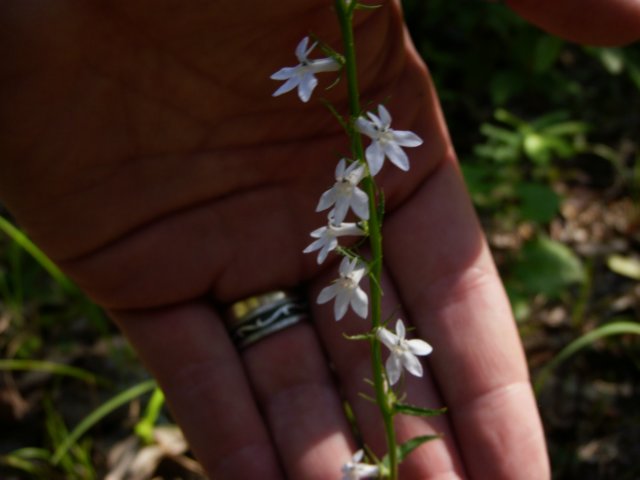
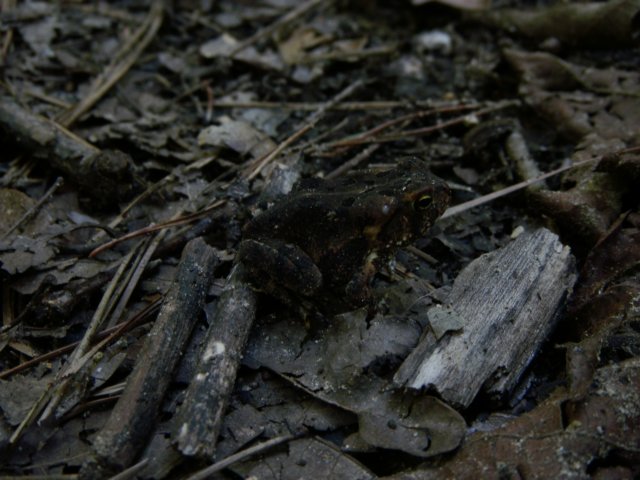
On our way back to the cars, we opted to take the very steep social trail up to the campsite with the meadow to save time and distance. When we arrived, it was time for another break, and of course, more photos of even more cranefly orchid. They especially seemed to like this area, and I also found rattlesnake plantain here, though not in bloom. The trek back uphill seemed to go easier for me this time, and through some short bursts, Parker and I raced each other until my loaded pack got to heavy for me to continue. We finally saw some creatures on the way out, a skink and a toad I nearly stepped on. One last surprise for us came in the form of pale-spiked lobelia. It is a fast favorite for me, one of the few varieties of lobelia here I hadn’t seen, and a great way to end our day.
We quickly found the junction, hiked upstream and always the daredevil, crossed on a shaky fallen log while the others rock hopped. To my surprise, we found a fire ring here in the bend of the creek, and we had to do some more clean-up work. I took several photos of an interesting tree that almost looked like it someone had carved a small passageway through the base of it. I’d remembered the advice I’d read about this place, to go over instead of hopping from one side to the other constantly, and heeded that. There were some really huge boulders, one of which was seemingly split in half, and made for a great photo, smothered in a variety of green mosses. I went down to a rocky section in the creek to photograph a small cascade type feature, and then back uphill again to photograph yet more cranefly orchids. With the flow less than promising, Mary and Parker opted to hang back, rest and have lunch, which I plowed ahead through a brief patch of thick brush. Larry joined me, and not far from where we split up, the canyon came to a halt and the familiar tall bluffs surrounded us on three sides, with Feather Hawk Falls all but a trickle slipping down from probably 70ft up. We rested and ate our lunch here on some long flat rocks just out of the spray of the falls itself.
On our way back to the cars, we opted to take the very steep social trail up to the campsite with the meadow to save time and distance. When we arrived, it was time for another break, and of course, more photos of even more cranefly orchid. They especially seemed to like this area, and I also found rattlesnake plantain here, though not in bloom. The trek back uphill seemed to go easier for me this time, and through some short bursts, Parker and I raced each other until my loaded pack got to heavy for me to continue. We finally saw some creatures on the way out, a skink and a toad I nearly stepped on. One last surprise for us came in the form of pale-spiked lobelia. It is a fast favorite for me, one of the few varieties of lobelia here I hadn’t seen, and a great way to end our day.
|